A woman I worked with—a lawyer in her early 40s—told me a story I haven't stopped thinking about.
She'd been at her firm for eight years. Competent. Reliable. Overlooked. The partners knew her name, but somehow she was never the first choice for the high-profile cases, never the one clients specifically requested.
Then she came to me. Not because she thought clothes were her problem—she came because she was tired of feeling invisible in her own closet every morning. We rebuilt her wardrobe from the ground up. Sharper silhouettes. A deliberate color palette. Pieces that fit like they were made for her body, not a mannequin.
Three weeks later, she called me, half-laughing, half-stunned.
"People are treating me differently," she said. "Same office. Same colleagues. But they're listening to me now. A senior partner asked for my opinion in a meeting—something that's never happened in eight years."
She hadn't changed her competence. Her intelligence. Her experience. She'd changed what she was wearing. And that changed how the world responded.

The Uncomfortable Truth About First Impressions
We like to believe we live in a meritocracy where substance matters more than surface. That people see past the packaging to evaluate what's inside.
They don't. At least, not at first.
Research consistently shows that people form judgments about competence, trustworthiness, and status within milliseconds of seeing you. Before you've opened your mouth. Before you've demonstrated any skill. Your clothes are doing the talking, whether you've scripted them or not.
This isn't superficial—it's evolutionary. Our brains are wired to make rapid assessments based on visual cues. And in modern contexts, clothing has become one of the primary signals we use to categorize and evaluate each other.
The pattern I see repeatedly with clients: they assume they're being judged on their work, when they're actually being filtered by their appearance before their work is even considered.
What Your Outfit Actually Communicates
Every outfit sends a message. The question isn't whether you're communicating—you are, constantly—but whether you're communicating what you intend.
Structure signals authority. Tailored pieces with defined shoulders and clean lines read as competent and in control. Slouchy, unstructured clothing reads as casual and approachable—which is fine when that's what you want, but disastrous when you need to command a room.
Fit signals self-respect. Clothes that fit your actual body—not too tight, not swimming—communicate that you pay attention to yourself. That you consider yourself worth the effort. When something pulls or gaps or hangs awkwardly, it subtly signals neglect.
Color signals intention. Muted neutrals read as sophisticated and serious. Bold colors read as confident and willing to be seen. Black reads as classic but can also read as hiding. White reads as fresh but demands impeccable maintenance.
Coordination signals control. When your outfit looks intentional—colors harmonizing, proportions balanced, accessories considered—it communicates that you have your life together. Randomness reads as chaos.
Stylist's Note: What surprises most women is how much the fit matters compared to the brand or price. A $50 blazer that fits perfectly will always outperform a $500 blazer that doesn't.
The Invisible Upgrade
Here's something I've observed in dozens of client transformations: when your wardrobe improves, opportunities appear that seem unrelated to clothing.
You get invited to the important meeting. The CEO strikes up a conversation in the elevator. Strangers make eye contact and smile. Service improves at restaurants and stores. People remember your name.
None of these people are consciously thinking "her blazer fits well, therefore I'll give her the promotion." But the unconscious calculation is happening nonetheless. You register as someone who matters. Someone who should be taken seriously. Someone worth investing in.
A client—an executive in her late 50s—resisted this idea initially. "I don't want to believe clothes matter that much," she told me. "It feels shallow."
But after we rebuilt her wardrobe and she started experiencing the shift, she reframed it: "It's not that I'm being fake. I'm just finally being seen accurately. My clothes now match my capability."
That's the flip. You're not deceiving anyone. You're removing the noise that was distorting the signal.
The Confidence Feedback Loop
Here's where it gets interesting: the external treatment shift triggers an internal one.
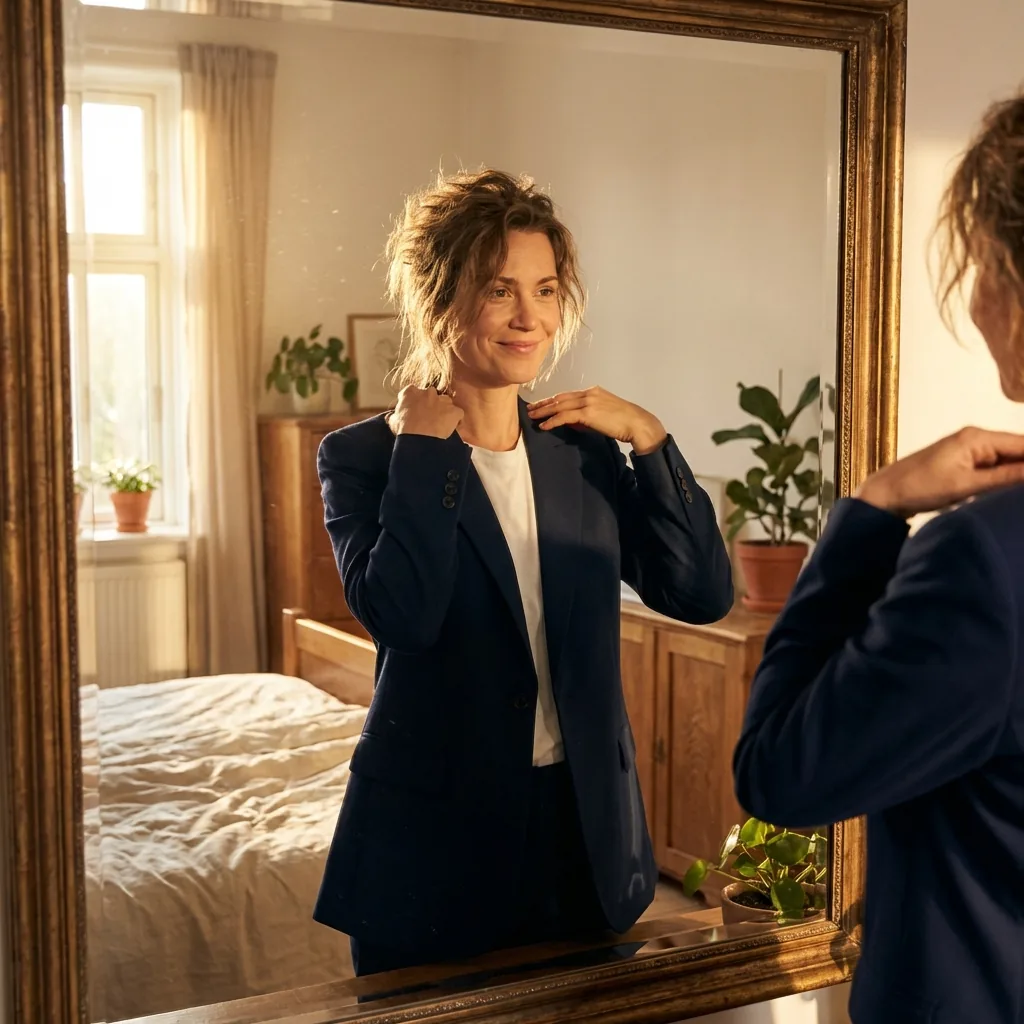
When you're dressed in a way that commands respect, you feel more authoritative. Your posture changes. Your voice steadies. You take up more space—literally and conversationally.
Other people register this confidence and respond to it. Which reinforces your confidence. Which changes how you carry yourself. Which changes how others respond.
It becomes impossible to separate the internal shift from the external one. They're feeding each other.
The woman I mentioned at the start—the overlooked lawyer—told me the strangest part wasn't how others changed. It was how she changed.
"I started speaking up in meetings without rehearsing first," she said. "I stopped apologizing before asking questions. And I know this sounds crazy, but I think I became more competent. Not just more confident—actually better at my job."
It doesn't sound crazy to me. When you're not spending mental energy worrying about whether your outfit is working, that energy goes somewhere else. Usually toward the actual work.
Building Your Influence Wardrobe
If you want to harness this—and there's no reason not to—here's where to start.
Audit your high-stakes situations. Where in your life do you need to be taken seriously? Client meetings? Board presentations? Salary negotiations? Networking events? Get specific about the contexts where perception matters most.
Study the visual language. In those contexts, what are the people with influence wearing? Not to copy them exactly, but to understand the baseline expectation. If everyone in power wears structured suits and you show up in flowing linen, you're sending a message—just probably not the one you want.
Invest in structure. A well-tailored blazer or jacket is the single most powerful piece for commanding presence. It builds your shoulders, defines your waist, and frames your face. This is where tailoring budget is never wasted.
Develop a signature element. The women who are truly memorable don't just follow the dress code—they have something distinctive. A bold lip. A statement watch. An unexpected color. Something that says this is intentional, and I know exactly who I am.
Stop dressing for comfort in discomfort zones. If you dress down because a situation makes you nervous, you're making yourself smaller at exactly the moment you need to be bigger. Dress for how you want to feel, not how you currently feel.
Pro Tip
The most powerful outfit isn't the most expensive one. It's the one that fits impeccably, coordinates intentionally, and makes you feel like you could handle anything that walks through the door.
What This Isn't
I'm not suggesting you perform a personality you don't have. I'm not suggesting you armor yourself in power suits if that's not authentic to you. And I'm certainly not suggesting that the solution to systemic bias is better clothes.
But I am suggesting this: you're already being judged on your appearance. You might as well be intentional about what that appearance communicates.
There's a version of you who walks into high-stakes situations knowing—not hoping, knowing—that you look exactly as capable as you are. That version of you isn't performing confidence. She's just not sabotaging it.
The distance between where you are and there is usually smaller than you think. Sometimes it's just one outfit away.
Ready for the shift? Our Outfit Engine Method → builds a complete wardrobe strategy around your specific goals, body, and life—so you can stop hoping your outfit works and start knowing it does.