You're standing in front of a closet full of clothes. Individually, every piece made sense when you bought it. That silk blouse was beautiful. Those wide-leg trousers were perfect. The statement blazer was exactly what you'd been looking for.
And yet, here you are, staring at all of it, unable to make a single outfit work.
The blouse clashes with everything. The trousers only look right with one top you've worn a hundred times. The blazer sits there, accusatory, because you've never found the right thing to wear under it.
If this sounds familiar—a closet full of items you love that refuse to combine into outfits you can actually wear—you've discovered the most common wardrobe problem I see: you're building a collection, not a wardrobe.
The Collection Problem

A collection is a group of individual pieces chosen in isolation.
You saw the blouse in a store, tried it on under specific lighting, loved how it looked on you in that moment, and bought it. You didn't think about what you'd wear it with. You didn't consider how its color temperature related to everything else you own. You bought it because it was beautiful, singular, complete in itself.
Then you went home and discovered it didn't work with any of your bottoms.
This is item-isolation thinking. Evaluating each piece on its own merits rather than its place in a system. And it creates closets that are full of gorgeous orphans—pieces that work alone but can't play with others.
A wardrobe, by contrast, is a system. Every piece exists in relationship to other pieces. Colors coordinate. Proportions balance. Items are chosen not just for their individual beauty but for their ability to multiply the options already available.
When you build a wardrobe instead of a collection, getting dressed becomes almost embarrassingly easy. Because everything works with everything. Because you can reach into your closet half-asleep and pull out a functional outfit.
Most women have collections. They dream of wardrobes.
Why Collections Happen
Collections aren't a failure of willpower. They're a failure of system.
Most women shop reactively. They need something for an event. They stumble across a sale. They feel uninspired by their closet and hope a new piece will fix it. They buy things that fill an emotional need in the moment rather than a strategic gap in their wardrobe.
None of this is wrong, exactly. It's just how retail is designed to work. Stores want you to fall in love with individual pieces. They display items in isolation under flattering light. They train you to evaluate things one at a time.
What they don't show you is how that piece will interact with everything else you own. Because that's not their problem.
It becomes your problem at 7 AM on a Tuesday, staring into a closet full of things that looked perfect in the store and don't work together at home.
Stylist's Note: When I do closet audits, I ask clients to pull everything out and sort by color. What they almost always discover: a chaotic rainbow of undertones. Cool pinks next to warm oranges. True reds next to burgundies with blue bases. No wonder nothing combines—the closet is a war of temperatures.
The Three Invisible Connectors
When pieces refuse to work together, there's usually a breakdown in one of three invisible systems: color temperature, proportion logic, or style language.
Color Temperature
Every color has an undertone—warm (yellow-based) or cool (blue-based). A navy with warm undertones is completely different from a navy with cool undertones. A beige that leans pink won't harmonize with a beige that leans gold.
Your eye registers these clashes even when you can't articulate them. Something just looks "off." The colors seem to fight rather than complement.
Most closets are a mix of warm and cool versions of the same colors. And that's why pieces don't combine—they're speaking different languages.
Proportion Logic
Every outfit has proportional relationships. The length of your top relative to your bottoms. The width of your pants relative to your shoe. The volume of a sleeve relative to what you tuck it into.
When pieces have conflicting proportional logic—a cropped boxy top with full-length wide trousers and delicate heels, for example—the outfit feels disjointed. Each piece is pulling in a different direction.
Collections accumulate pieces without considering how their proportions interact. Wardrobes are built with consistent proportional relationships, so pieces combine predictably.
Style Language
Every piece speaks a visual language. Minimalist and structured. Bohemian and relaxed. Classic and traditional. Modern and edgy.
When pieces speak different languages, outfits feel confused. A romantic ruffle blouse with sharp tailored trousers and chunky combat boots isn't "eclectic"—it's incoherent. Unless the clash is extremely intentional, mixing languages creates visual noise.
Most collections contain pieces from multiple style languages acquired at different life phases. The relaxed stuff you bought when you wanted to be effortless. The structured stuff from your corporate phase. The trendy stuff from when you tried something new.
All sitting together, refusing to combine.
Pro Tip
If you're constantly struggling to finish outfits—the top works but the shoes feel wrong, or the pieces are fine but the look isn't landing—you likely have a language or temperature mismatch rather than a piece problem.
The Architecture Shift
The fix isn't to throw everything away and start over. It's to start thinking architecturally.
Wardrobe architecture means building from foundations up. Base pieces first. Connectors second. Statement pieces last.
Foundations are the neutrals and basics that combine with almost everything. They're carefully chosen for consistent color temperature and proportion logic. In a well-architected wardrobe, every foundation piece works with every other foundation piece.
Connectors are pieces that bridge between foundations and statements. They introduce color, pattern, or interest while still playing well with the basics. They're the layer that makes outfits interesting without making them complicated.
Statements are the pieces that express your personal style most visibly. They don't need to work with everything—they need to work with your foundations and at least one or two connectors. They're chosen last, after the system is in place.
Most collections are heavy on statements and light on foundations. Women buy the interesting stuff first and assume basics are boring. Then they wonder why nothing combines.
The Color Edit
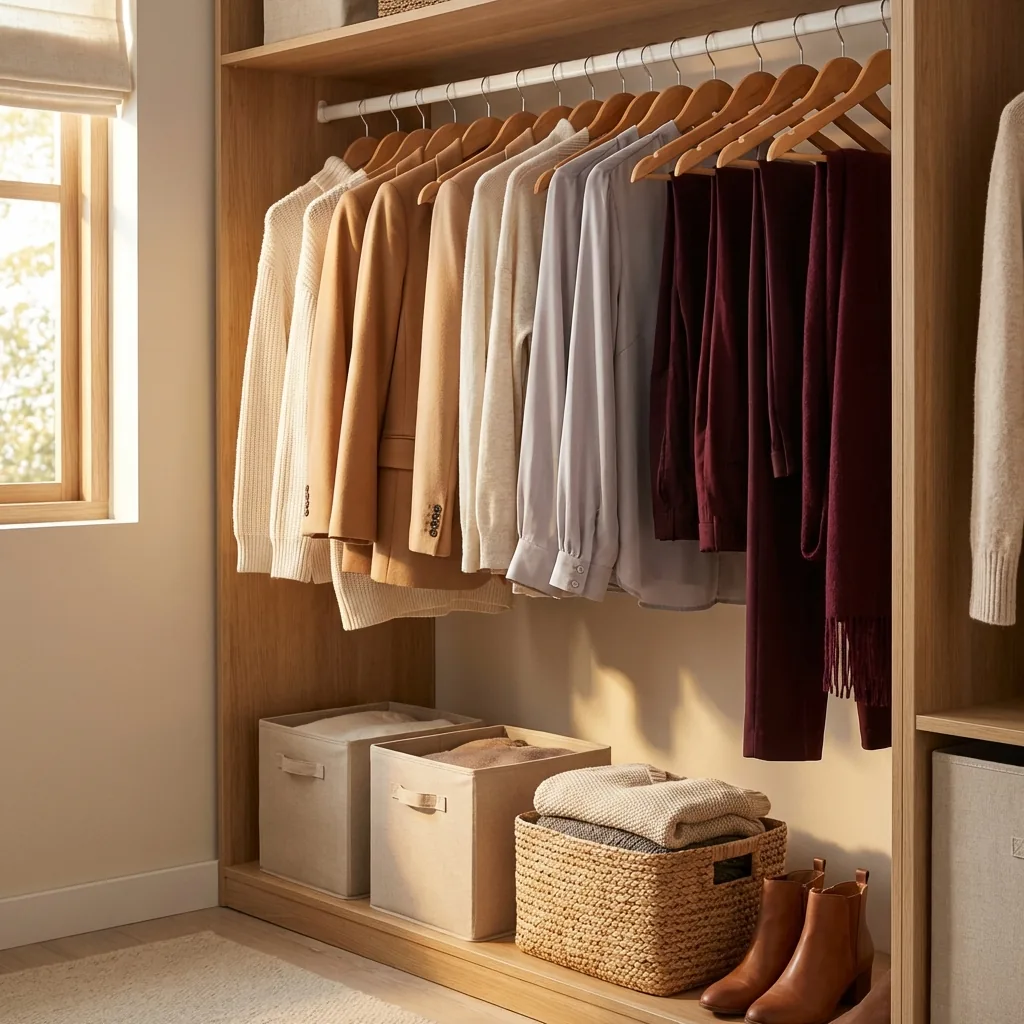
If I could do one thing for every woman's closet, it would be this: establish a color palette and stick to it.
This sounds restrictive. It's actually liberating.
A functional palette contains:
- 2-3 true neutrals (black, white, navy, grey, beige—but all in the same temperature)
- 2-3 accent colors that work with the neutrals and with each other
- 1-2 statement colors you love and can build around
When every color in your closet belongs to the same palette—same temperature, same tonal family—combining becomes automatic. Any top works with any bottom because the colors were chosen to coordinate from the start.
A woman came to me with a closet full of "neutrals" that didn't work together. When we sorted them by temperature, the problem was obvious: half were warm (olive, camel, cream with yellow undertones) and half were cool (charcoal, navy, cream with pink undertones). She had two half-wardrobes instead of one full one.
We chose a direction—her coloring suited warm tones better—and gradually edited out the pieces that didn't belong. Within six months, she had half the clothes and double the outfit options. Because everything finally spoke the same language.
The Proportion Principle
Once color is consistent, proportion becomes the next lever.
This doesn't mean every piece needs to be the same cut. It means understanding how pieces interact.
Volume balance: If a piece is oversized on top, the bottom should be fitted. If the bottom is voluminous, the top should be sleek. Matching volume top and bottom creates shapelessness.
Length relationships: Where your top hits relative to your waist and hips affects your proportions. Where your pants hit relative to your shoe changes your silhouette. These relationships should be consistent and intentional.
Anchor points: Every outfit should have at least one anchor point—a defined waist, a strong shoulder, a hemline that grounds the look. Without an anchor, outfits float.
When you buy pieces with the same proportional logic—you favor tailored over slouchy, cropped over oversized, high-waisted over low—they automatically combine because they share assumptions about how to interact with your body.
Building Instead of Buying
The shift from collection to wardrobe is a shift from buying to building.
Before you acquire anything, ask:
- Does this work with at least 5 things I already own?
- Does it share a color temperature with my current palette?
- Does it speak the same style language as my foundational pieces?
- Does it fill a gap or just duplicate something I have?
If you can't answer yes to the first three questions, the piece will become another orphan. No matter how beautiful. No matter how good the sale.
The test: Before you buy something, mentally dress it with things already in your closet. Not one outfit—at least three. If you can't easily create three combinations, you're buying an item, not adding to your system.
This sounds strict. It is. But the result is a closet where you could literally reach in blindfolded and pull out a working outfit. That ease is worth the discipline.
The Gap Strategy
When you think architecturally, shopping changes completely.
Instead of wandering stores hoping something will speak to you, you shop with specific gaps in mind. You know your palette, your proportions, your style language. You know what's missing.
Maybe you have plenty of fitted tops but no relaxed options that still work with your bottoms. Maybe you have neutral foundations but no connectors to add interest. Maybe you have everything for cool weather but gaps in transitional pieces.
With a gap strategy, shopping becomes almost boring. You're not looking for inspiration or excitement. You're looking for the specific piece that completes the system. You find it, you buy it, you leave.
And because it was chosen to fit the architecture, it integrates immediately. No orphan. No buyer's remorse. Just another piece that multiplies your options.
What Changes
When you build a wardrobe instead of a collection, getting dressed transforms.
The paralysis lifts. The "nothing to wear" feeling disappears. The frantic pre-event shopping stops because you already have pieces that work for almost any situation.
You stop buying more because more doesn't make it better. A hundred orphaned pieces can't compete with thirty that function as a system.
And something subtler happens: you start looking more put-together without trying harder. Because every piece was chosen to coordinate, even your most thrown-together outfits have an intentional quality. Colors harmonize. Proportions balance. Nothing fights.
That's the gift of architecture over accumulation. Not restriction—freedom. The freedom of a closet where everything works.
Ready to transform your collection into a wardrobe that actually functions? The Outfit Engine Method → builds your personal architecture from the ground up—so getting dressed becomes the easiest part of your morning.