Open your closet. Don't touch anything—just look.
What do you see?
Not the individual items. Not the colors or the labels. Look at the feeling of it. Is it chaotic or controlled? Cramped or spacious? Full of possibilities or heavy with guilt?
That closet is a physical manifestation of your internal landscape. And it's telling you things about your life that you might not be ready to hear.
The Archaeology of Self
Every piece of clothing in your closet entered your life at a specific moment, for a specific reason. Some were hopeful—you imagined a version of yourself wearing this, living some better life. Some were practical—you needed something, anything, for that event tomorrow. Some were impulsive—the dopamine hit of a sale tag, the brief thrill of new.
And then they stayed. Long past their welcome. Long past their relevance.
I've opened hundreds of closets in my work. And in every single one, I find a story. Not about fashion—about the woman who owns it. Her hopes. Her fears. Where she's stuck.
The sections that are overcrowded reveal where you're overcompensating or hiding. The sections that are empty reveal what you're avoiding. The things with tags still on reveal who you're waiting to become.
It's all there. Written in fabric and zipper and hem.
The Five Closet Archetypes
Over years of client work, I've noticed that wardrobes tend to fall into patterns. Not strict categories—more like gravitational pulls. See if you recognize yourself.
The Museum
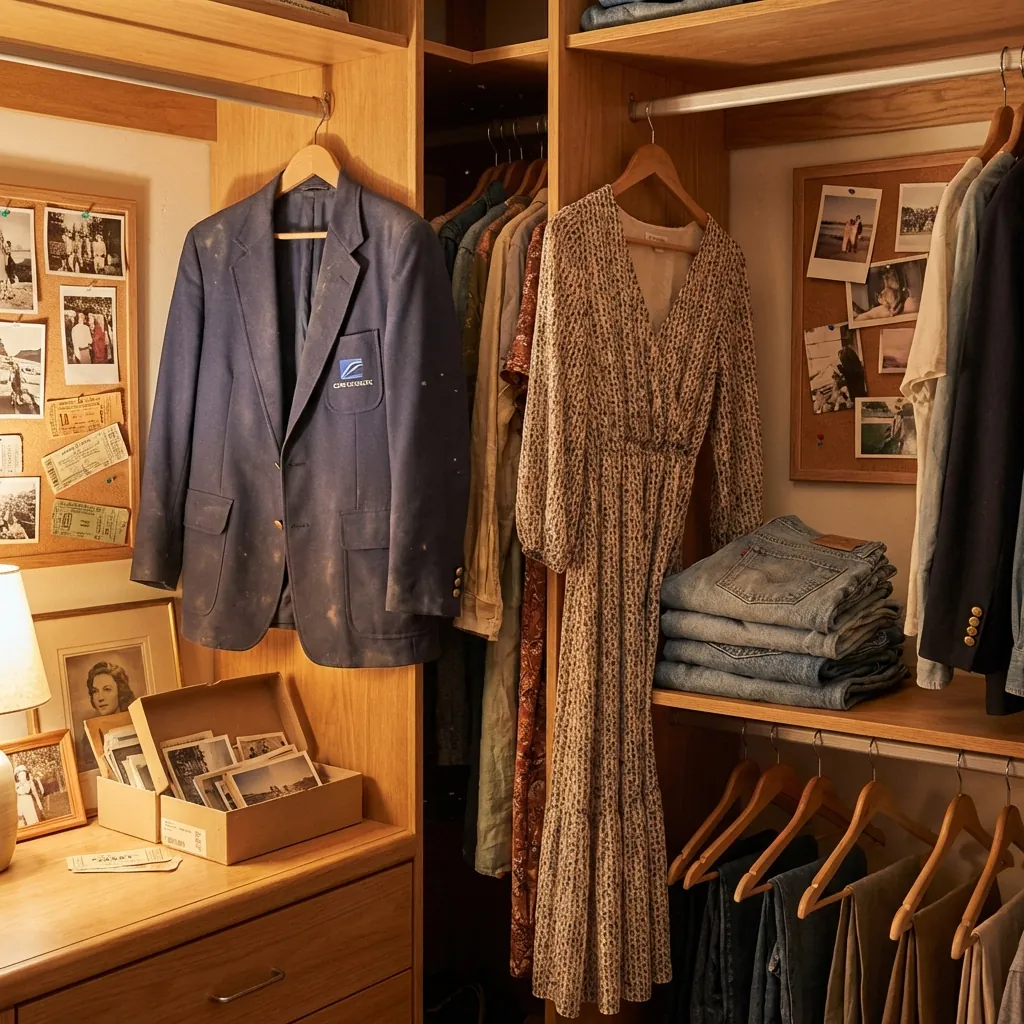
Clothes from every era of your life, carefully preserved but rarely worn. The blazer from your first real job. The dress you wore on that trip to Paris. The jeans from before the babies.
The museum closet belongs to a woman who struggles to let go—not of clothes, but of identities. She keeps these pieces because she's not ready to say goodbye to who she was. The clothes are proof that those versions of herself existed.
What it reveals: A fear of moving forward. A sense that your best chapters might be behind you. An attachment to who you've been that's blocking who you could become.
The shift: Take photos of the pieces that hold the strongest memories. The photo preserves the memory—the physical object doesn't have to. Let the clothes move on to someone who will actually wear them.
The Costume Department
Racks full of bold, statement pieces. Unique finds. Things that look incredible on the hanger but somehow never make it onto your body. A closet full of "going out" clothes for a woman who rarely goes out.
The costume department belongs to a woman who's collected an identity she doesn't actually live. She knows who she wants to be, but her real life doesn't have a stage for that character.
What it reveals: A gap between fantasy self and daily reality. A belief that your current life isn't worthy of the best version of you. A longing for a different context entirely.
The shift: Stop waiting for your life to match your clothes. Start wearing the statement pieces to mundane places. Become the woman who wears the bold earrings to the grocery store. The costume department only becomes a wardrobe when you actually wear it.
The Uniform Bunker
Thirty variations of the same safe outfit. Different colors of the same tee. Multiple versions of the same cut of jeans. A closet that values safety over self-expression.
The uniform bunker belongs to a woman who has found something that works and is terrified to deviate. She's made getting dressed efficient—but at the cost of making it joyful.
What it reveals: Fear of visibility. A desire to blend in rather than stand out. Possibly exhaustion—choosing comfort because everything else in life already takes so much energy.
The shift: Keep the uniform as your foundation, but add one element of interest. A scarf with personality. A red lip. Earrings that catch light. You don't have to blow up the safety—just punctuate it.
The Just-In-Case Archive
Clothes held onto for hypothetical futures. The formal dress for the event you might be invited to. The ski gear for the trip you keep meaning to take. The "goal weight" jeans that have been waiting for three years.
The just-in-case archive belongs to a woman who lives in the conditional tense. She's preparing for a life she isn't living—and cluttering her present with her projected future.
What it reveals: Difficulty living in the now. A belief that real life starts "when"—when you lose weight, when you get the promotion, when the kids are older. A subtle self-punishment disguised as optimism.
The shift: Set a deadline. If the formal event hasn't happened in a year, the dress goes. If the ski trip hasn't happened in two winters, the gear goes. Stop storing for a life you're not actively building.
The Guilt Gallery
Expensive purchases you never wear. Gifts from people you love that aren't remotely your style. The "good deal" items that weren't actually a deal because you've never put them on.
The guilt gallery belongs to a woman who struggles to honor her own preferences when they conflict with external expectations. She can't donate the ugly sweater her mother gave her because getting rid of it feels like betrayal.
What it reveals: Difficulty setting boundaries. A tendency to prioritize others' feelings over your own needs. Guilt about money, about waste, about being seen as ungrateful.
The shift: Understand that keeping something you'll never wear doesn't honor the money spent or the person who gave it. It just adds guilt to your daily life. You can love someone and not love what they give you. Both things can be true.
Pro Tip
The pieces you feel most guilty about are the ones to examine most carefully. Guilt is a signal that a boundary needs to be set—with yourself, with others, or with your own expectations.
The Spaces Between
Sometimes the most revealing thing isn't what's in your closet—it's what's missing.
No comfortable clothes? You might be living for others' approval rather than your own comfort.
No clothes for going out? You might be putting your social life on indefinite hold.
No clothes that feel you? You might not know who that is yet—and that's okay. But it's worth noticing.
The gaps tell you where you've stopped investing in entire categories of your life. A woman I worked with—a marketing director in her late 30s—had an extensive work wardrobe and absolutely nothing for weekends. When I asked about it, she got quiet.
"I guess I don't really have a weekend life anymore," she said. "Everything is work or... recovery from work."
Her closet was showing her something she hadn't been willing to see. The absence was a message.
Reading Your Own Closet
Try this: Stand in front of your open closet for five minutes. Don't organize. Don't purge. Just observe.

Ask yourself:
What am I avoiding looking at? The section you never touch often holds the most information.
What tells me I'm stuck? The pieces that haven't been worn in years but you can't let go of—why are they still there?
What represents who I want to be? Do you actually wear those pieces, or are they aspirational anchors?
What's missing entirely? What category of your life has no representation in your wardrobe?
What would stay if I only kept the things that feel like me? Not "me on a good day" or "me at my goal weight" or "me if I had a different life"—me, right now, as I actually am.
What Comes Next
Understanding your closet's secrets isn't the same as fixing them. Awareness is the first step, not the last.
But here's what I've learned from doing this work: once you see the patterns, you can't unsee them. The museum curator starts letting go of old identities. The costume collector starts wearing her treasures. The uniform wearer adds a flash of personality.
Your closet is trying to tell you something. The question is whether you're ready to listen.
And if you're not ready to do this alone—if you want someone who can see your patterns clearly and help you build something new—that's exactly what I'm here for. Sometimes we're too close to our own stories to read them accurately.
But the clothes will show us. They always do.
Ready to decode your closet with expert support? Our Outfit Engine Method → combines wardrobe analysis with personalized strategy—so you can finally build a closet that reflects who you are, not who you were.