Tell me if this sounds familiar.
A wedding invitation arrives. You spend weeks thinking about what to wear. You try things on. You research. You might even buy something new. You consider the shoes, the bag, the jewelry. You show up looking incredible—and you feel incredible.
Then Monday comes. You shuffle to the closet in the gray morning light and grab whatever's clean. The same jeans. The same sweater. Whatever doesn't require thought. You spend your actual life—the ordinary, Monday-through-Friday, nothing-special days—in clothes that don't make you feel anything at all.
The wedding outfit? That version of you? She only exists for other people's events.
The Hidden Hierarchy
Somewhere along the way, most women internalize a hierarchy of worthiness. Some occasions deserve effort. Most don't.
Work events: worth dressing up. Date nights: worth dressing up. Friend's birthday: worth dressing up. Important meetings: worth dressing up. Your regular Wednesday: not worth it. Working from home: definitely not worth it. Running errands: are you kidding?
Look at that list carefully. Notice something? All the "worth it" occasions have one thing in common: other people are watching.
The implicit belief underneath is devastating when you spell it out: I'm only worth effort when someone else is there to see it.
What This Pattern Actually Costs
You might think dressing down for everyday life is practical. Comfortable. Low-maintenance. And in isolation, it is.
But zoom out to the cumulative effect over months and years, and something else emerges.
Your self-image erodes. You see yourself in the mirror five, ten, twenty times a day. If what you see every single time is "tired" and "minimal effort," that becomes your baseline sense of self. The wedding version of you starts to feel like a costume. The everyday version feels like the real one.
Your energy follows your appearance. This isn't magical thinking—it's documented. When you dress with intention, you stand differently. You engage differently. Your brain registers that today matters. When you dress like nothing matters, your brain agrees.
You reinforce your own invisibility. The woman who only appears for others' occasions has internalized that her own time isn't worth showing up for. Her ordinary days are placeholders between the events that count.
A client in her mid-40s told me something that stopped me cold. "I realized I've spent the last decade waiting for my real life to start," she said. "Waiting for the kids to be older. Waiting for the next job. Waiting for... I don't even know what. And in the meantime, I've been dressed like someone in a waiting room."
The Lie of "Saving" Your Nice Things
This connects to another pattern I see constantly: the untouched treasures.
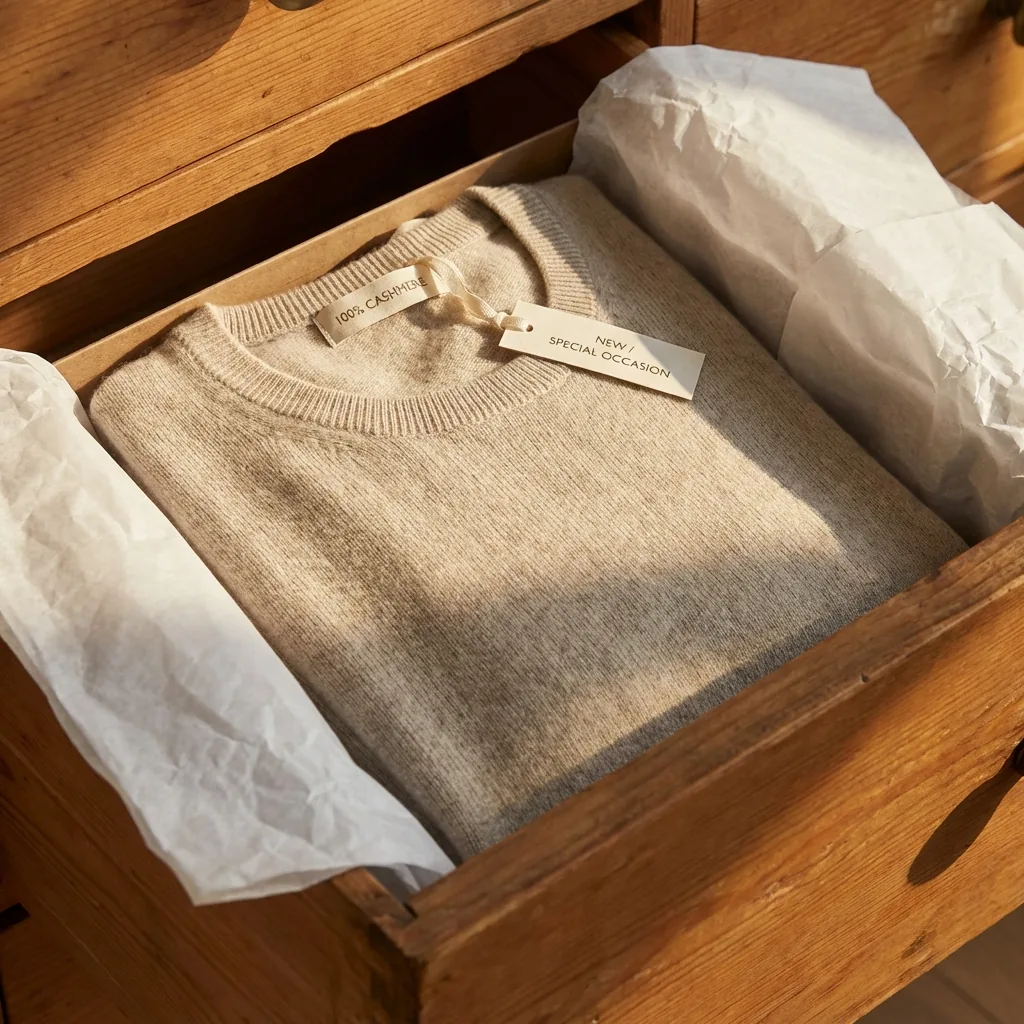
The cashmere sweater still folded in tissue paper. The silk blouse you're saving for "the right occasion." The jewelry that sits in a box because it feels too nice for regular life.
Stylist's Note: What surprises most women is realizing they've been saving their best for a future that keeps receding. The right occasion never comes because no occasion feels special enough. Meanwhile, years pass. The cashmere doesn't get worn. Your life happens anyway.
Here's the thing: fabric doesn't improve with age. Cashmere doesn't appreciate in value sitting in a drawer. Your unworn treasures aren't investments—they're guilt with price tags attached.
And the "right occasion"? It was always fiction. The right occasion is any day you're alive and have the option to feel beautiful.
Where This Comes From
This isn't random. It's cultural conditioning. Women are taught from childhood that our appearance is for others' consumption. We dress to be seen. To attract. To impress. To not embarrass.
The audience is always external.
So when the external audience disappears—when we're home alone, or doing mundane errands, or just living our regular lives—the motivation evaporates. Why would you dress up for yourself? Who would see?
But here's what that conditioning misses: you see. You're the one living in your body all day. You're the one who catches glimpses of yourself in windows. You're the one who knows what you're wearing under the coat.
The most important audience is the one you're trying to convince doesn't exist.
The Permission Shift
What would change if you decided your ordinary days deserved the same care as your special occasions?
Not the same formality—you don't need to wear cocktail dresses to the grocery store. But the same intention. The same sense that how you present yourself matters because you matter, regardless of who else might be watching.
This is what I mean by dressing for yourself. Not vanity. Not self-absorption. Just the radical act of treating your own life as worthy of showing up for.
A woman I worked with—a freelance writer who worked from home—told me she'd spent years in leggings and old sweatshirts. "No one sees me," she said. "What's the point?"
We didn't overhaul her wardrobe with blazers and heels. We found her version of intentional comfort. Soft knits that actually fit. Trousers that felt good but didn't look like she was heading to the gym. Simple jewelry she could wear every day.
"The strangest thing happened," she told me a few weeks later. "My work got better. I was more productive. I took myself more seriously."
She hadn't changed her schedule. Her skills. Her deadlines. She'd just stopped dressing like someone in hiding.

Pro Tip
You don't have to dress up to dress intentionally. The goal isn't formality—it's care. It's choosing what you wear instead of defaulting to whatever's closest. It's treating yourself like someone worth the effort.
How to Break the Pattern
This isn't about throwing out all your comfortable clothes. It's about closing the gap between "special occasion you" and "everyday you."
Wear your nice things. The candle you're saving? Light it. The cashmere you're protecting? Put it on. Things don't become special by hoarding them. They become special by being part of your lived experience.
Eliminate the "nothing to see here" category. Those clothes you only wear when no one will see you—why do they exist? If they're truly just for sleep or cleaning, fine. But if you're wearing them for entire days of your life, they're not loungewear. They're your actual wardrobe.
Create everyday rituals. Jewelry. Lipstick. A scarf. Something small that signals to your brain: I'm showing up today. Not for a meeting. Not for an event. For my own life.
Stop waiting for the invitation. Dress like today is the day something interesting might happen. Because it might. And because even if it doesn't, you're still here, living it.
Ask the uncomfortable question. Look at your everyday clothes and ask: would I feel embarrassed if someone important saw me right now? If yes—why are you okay being seen this way by the person who matters most?
The Deeper Truth
Here's what this comes down to: the way you dress when no one is watching reveals what you believe about yourself when no one is watching.
Do you believe your ordinary days are just filler between the moments that matter? Do you believe you're only worth effort when you have an audience? Do you believe your real life hasn't started yet?
Or do you believe that today—this regular, unremarkable, nothing-special day—is worth showing up for?
Your clothes are making that statement whether you're conscious of it or not.
The woman who dresses with intention for her own morning coffee is making a declaration about her own worth. Not to Instagram. Not to her colleagues. To herself.
And that's the audience that actually shapes everything.
Ready to close the gap between "special occasion you" and "everyday you"? Our Outfit Engine Method → creates a wardrobe that makes intentional dressing easy—so every day feels like you're worth the effort. Because you are.