You know that moment. You're at an event—a wedding, a work function, someone's birthday. You caught a glimpse of yourself in the bathroom mirror earlier and felt genuinely good. The outfit worked. Your makeup was right. Everything clicked.
Then someone posts the photos.
You scroll through, searching for yourself with that specific dread reserved for seeing your own image in a context you didn't control. And there you are. Except it's not you. Or it is you, but some distorted version—shorter, wider, duller than the woman who walked out of that bathroom feeling confident.
You wonder if you've been delusional. If the mirror has been lying to you this whole time. If everyone else saw this version while you were walking around believing in the other one.
Here's the truth: you weren't delusional. But you were dressing for the wrong context.
The Fundamental Disconnect
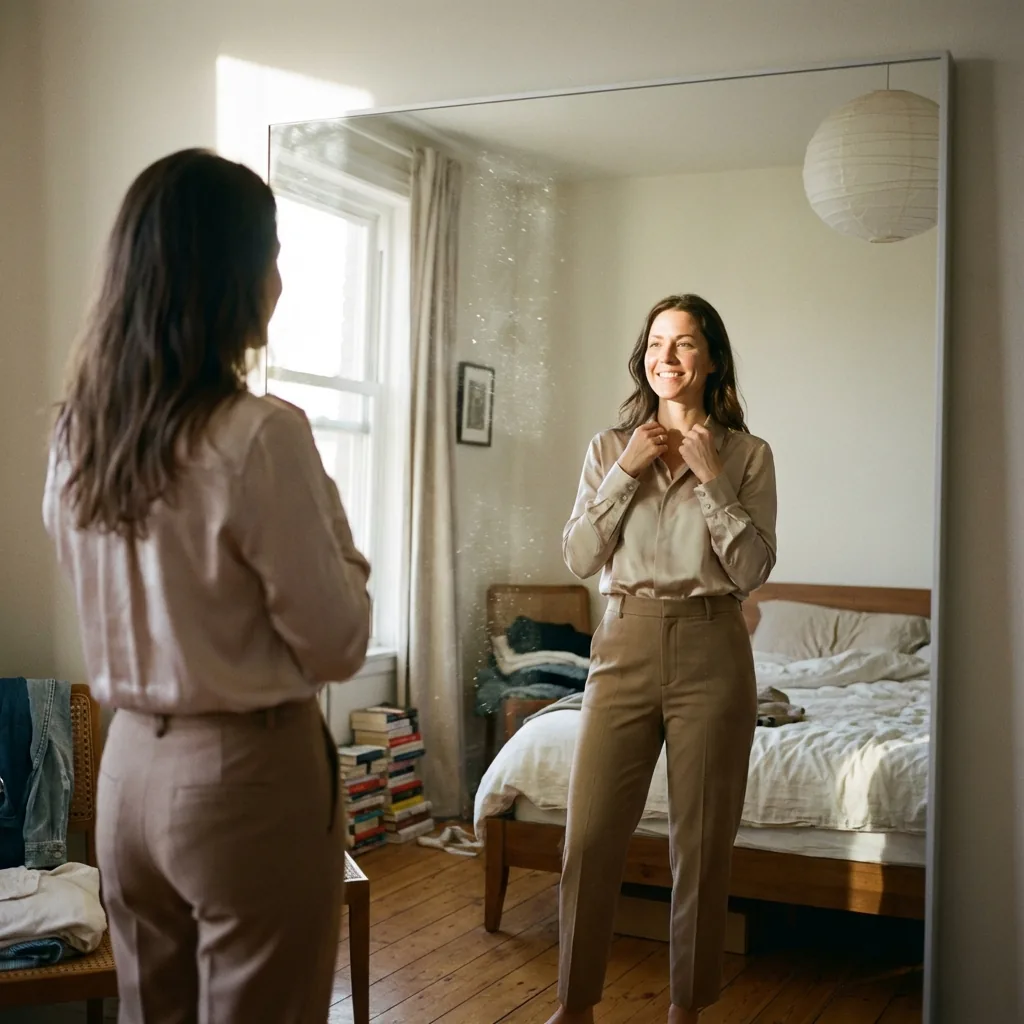
The mirror shows you a static, two-dimensional, front-facing image in controlled lighting that you've unconsciously adjusted to look best. You stand up straighter when you look at yourself. You angle slightly. You see yourself at a distance and in a position you've optimized over years of looking.
Photos capture you in three dimensions, in motion, from angles you've never seen yourself from, in lighting you didn't choose.
If you look great in the mirror but terrible in photos, you're dressing for a frontal still image. Real life—and real cameras—happens everywhere else.
This is why some women photograph beautifully regardless of the angle or moment, while others can look stunning in person but consistently disappoint in pictures. It's not that some people are photogenic and some aren't. It's that some people have stumbled onto the principles of three-dimensional dressing, and others are still optimizing for the mirror.
The Three-Dimensional Problem
Here's what most women don't realize: your outfit exists in space. It has a front, a back, sides. It has a silhouette that changes when you move. It catches light from every direction. It bunches, pulls, and shifts when you sit, walk, or turn.
The mirror only shows you one angle. And it's always the angle you've trained yourself to see.
Stylist's Note: When I do wardrobe audits with clients, I have them photograph every outfit from multiple angles—front, side, back, and sitting. The reactions are always the same. "I had no idea it did that in the back." "Why does it look so different from the side?" Because they'd only ever seen the front.
A blazer that looks sleek from the front might pull awkwardly across the shoulder blades. A dress that seems perfectly fitted in your reflection might add ten pounds from the side because of how the fabric gathers at your hip. A neckline that looks elegant straight-on might gap or twist the moment you turn your head.
You've been optimizing for a fraction of how you actually appear in the world.
What the Camera Actually Sees
Cameras flatten. They compress dimension. They don't adjust for context the way human eyes do.
When someone looks at you in person, their brain processes you holistically—your movement, your expression, your energy, your proportions relative to the space around you. A camera captures a single instant, stripped of all that context, and freezes it forever.
This means certain things that work in person fail in photos:
Busy patterns create visual noise that reads as chaotic in a still image but can look interesting in motion.
Precise color matching (like a top that exactly matches a bag) looks intentional in real life but can look like you're trying too hard in photos—or worse, like the items are bleeding into each other.
Subtle details that you love—delicate jewelry, interesting texture, a perfectly placed button—often disappear entirely in photos, leaving you with a plain-looking outfit.
Monochromatic outfits that look sophisticated in person can read as a shapeless block of color in photos because the camera can't distinguish the subtle tonal variations your eye picks up.
Meanwhile, certain things that might feel "too much" in person actually photograph better:
Contrast. The camera loves clear separation between elements.
Statement pieces. What feels bold in the mirror reads as confident and intentional in photos.
Defined structure. Sharp shoulders, clear waistlines, and distinct shapes hold their form in photos instead of melting into ambiguity.
The Movement Problem
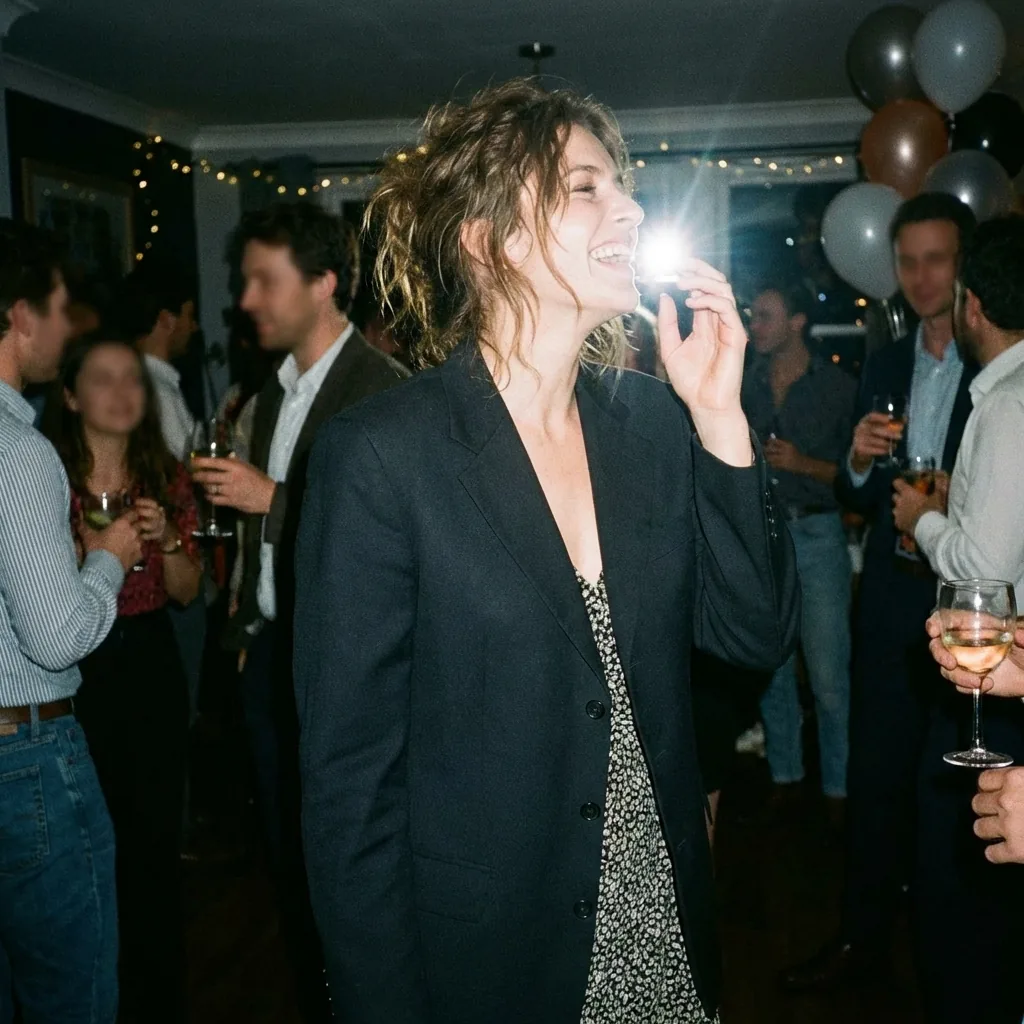
A client of mine—a TV producer in her mid-30s—came to me because she was consistently horrified by event photos despite feeling good when she got dressed.
When we analyzed the patterns, the problem was clear: she dressed in soft, fluid pieces that looked beautiful when she stood still and arranged them perfectly. The moment she moved, sat down, or was caught mid-gesture, those same pieces betrayed her. The fabric shifted. The proportions collapsed. The silhouette that worked in the mirror dissolved into something shapeless.
We restructured her wardrobe around pieces that maintained their shape regardless of position. Tailored jackets that stayed put. Dresses with internal structure. Fabrics with enough weight to drape predictably.
The next event photos? She looked like herself. Not a carefully posed version of herself—actually herself, in motion, from any angle.
The difference wasn't the lighting or the photographer. It was that her clothes finally worked in the dimension where photos are captured.
The Lighting Equation
Here's something that will change how you think about getting dressed: the lighting in your bedroom, bathroom, or closet is probably the most forgiving light you'll ever be in.
It's designed to flatter. Warm tones, diffused sources, positioned to minimize shadows. You've been making outfit decisions in a context that doesn't translate to anywhere else you'll actually wear those clothes.
Event lighting is typically overhead and harsh. Office lighting is fluorescent and cold. Outdoor photos catch you in direct sun that casts shadows across your face and body.
Colors shift dramatically across these contexts. That perfect olive top that looks sophisticated in your bathroom mirror might read as sickly under office fluorescents or muddy in harsh outdoor light. The deep burgundy that makes your skin glow at home might wash you out completely under the cool LED lights at a restaurant.
This is why color-testing in multiple light contexts matters. When I work with clients, we photograph potential pieces in at least three different lighting environments before committing. Because looking great in one light and terrible in another isn't about the garment being bad—it's about it being wrong for where you'll actually wear it.
Pro Tip
Before you commit to an outfit for an event, step outside in natural light and take a quick photo. The gap between what you see in your bathroom mirror and what the camera captures in real-world lighting will tell you everything you need to know.
The Proportion Illusion
Mirrors reverse your image. You're seeing yourself flipped. And while this sounds minor, it means you've never actually seen yourself the way others see you—or the way cameras capture you.
More importantly: mirrors show you exactly at eye level, from the exact distance you've chosen, in a proportion that feels familiar because you've seen it thousands of times.
Photos are taken from varying heights, distances, and angles. A camera positioned slightly below you (common at events, when photographers are crouching to get the whole group) can make you look bottom-heavy. A camera positioned from far away compresses your proportions. A camera close up distorts your features.
The outfit that looks perfectly proportioned in your mirror might fall apart completely when the perspective shifts.
This is why the rules about proportion matter more in photos than in mirrors. Where your waist hits, where your hemlines fall, how long your torso appears relative to your legs—these become exaggerated by the camera.
If you consistently look shorter or wider in photos than you feel in person, it's often because your proportions are optimized for a head-on, eye-level view. A few adjustments—raising your waistline, adjusting your hem length, being strategic about color blocking—can dramatically change how your proportions translate to the camera.
How to Start Dressing for How You're Actually Seen
The goal isn't to become obsessed with how you photograph. It's to close the gap between how you feel when you get dressed and how you appear in the moments you can't control.
First: get comfortable with the side view. Start photographing your outfits from the side before you leave. This single change reveals 80% of what's going wrong. You'll see bunching you never noticed, proportions that don't work, silhouettes that collapse.
Second: test in motion. Sit down in your outfit. Walk around. Bend over. Raise your arms. Does everything stay where it should? Or does the whole structure fall apart the moment you're not standing perfectly still?
Third: introduce contrast. The camera needs separation between elements. If you're wearing navy pants and a dark blue top, you're wearing a blob from the camera's perspective. Create clear visual breaks—a belt, a contrasting layer, a different value top to bottom.
Fourth: choose structure over softness for high-stakes events. Save the flowy fabrics and delicate pieces for contexts where you control how you're seen. For events where photos will be taken, choose pieces with enough structure to hold their shape regardless of angle or movement.
Fifth: accept that photogenic dressing is a skill. Some women have developed it intuitively over years. Others need to learn it deliberately. Neither approach is better, but pretending it doesn't exist—pretending that how you look in photos should just match how you feel in the mirror—sets you up for disappointment every time.
The Deeper Issue
There's something painful about seeing yourself in photos and not recognizing the person you thought you were.
It shakes your confidence. It makes you question your judgment. It creates a quiet anxiety before every event where cameras might appear.
But here's what I want you to understand: the woman in the mirror isn't a lie. You aren't delusional about how you look. You've just been dressing for one context and being captured in another.
When you learn to dress for three dimensions—for movement, for angles, for light you don't control—the gap closes. The woman in the photos starts to match the woman in the mirror. Not perfectly, because no photo captures the full experience of someone in real time. But close enough that you can stop dreading the tag notifications.
Close enough that you can be present at events instead of strategically avoiding cameras.
Close enough that you can trust your judgment again.
If the gap between how you feel and how you photograph has been driving you crazy, this is exactly what our styling process addresses →. We build wardrobes that work in three dimensions, not just in your mirror.